


Published TCIMAIL newest issue No.200
Maximum quantity allowed is 999
| Taille | Prix unitaire | Belgique | Japon * | Quantité |
Informations d'expédition

|
|---|---|---|---|---|---|
| 1G |
€69.00
|
6 | ≥100 |
|
|
| 5G |
€220.00
|
2 | ≥60 |
|
*Stock disponible en Belgique : Expédition le jour même
*Stock disponible au Japon : Veuillez consulter la simulation d'expédition pour une estimation des délais d'expédition (hors articles réglementés et expédition avec Carboglace)
| Numéro de produit | T2584 |
Pureté / Méthode d'analyse 
|
>98.0%(T) |
| Formule moléculaire / poids moléculaire | C__1__2H__2__8BF__4P = 290.13 |
| Etat physique (20 ° C) | Solid |
| Condition de stockage
|
Room Temperature (Recommended in a cool and dark place, <15°C) |
| Emballage Et Conteneur
|
1G-Glass Bottle with Plastic Insert (Voir l'image) |
| CAS RN | 131274-22-1 |
| Numéro de registre de Reaxys | 8813613 |
| Identifiant de la substance PubChem | 125307337 |
| Numéro MDL | MFCD04039975 |
| Appearance | White to Almost white powder to crystal |
| Purity(Iodometric Titration) | min. 98.0 % |
| NMR | confirm to structure |
| Point de fusion | 261 °C |
| Pictogramme |


|
| Mot de signal | Danger |
| Mentions de danger | H302 : Nocif en cas d'ingestion. H314 : Provoque des brûlures de la peau et de graves lésions des yeux. |
| Conseils de prudence | P260 : Ne pas respirer les poussières. P280 : Porter des gants de protection/ des vêtements de protection/ un équipment de protection des yeux/ du visage/ auditive. P303 + P361 + P353 : EN CAS DE CONTACT AVEC LA PEAU (ou les cheveux): Enlever immédiatement tous les vêtements contaminés. Rincer la peau à l'eau. P301 + P330 + P331 : EN CAS D'INGESTION: Rincer la bouche. NE PAS faire vomir. P304 + P340 + P310 : EN CAS D’INHALATION: transporter la personne à l’extérieur et la maintenir dans une position où elle peut confortablement respirer. Appeler immédiatement un CENTRE ANTIPOISON/un médecin. P305 + P351 + P338 + P310 : EN CAS DE CONTACT AVEC LES YEUX: Rincer avec précaution à l'eau pendant plusieurs minutes. Enlever les lentilles de contact si la victime en porte et si elles peuvent être facilement enlevées. Continuer à rincer. Appeler immédiatement un CENTRE ANTIPOISON/un médecin. |
| Numéro UN | UN1759 |
| Classe | 8 |
| Groupe d'emballage (DOT-AIR) | III |
| N ° SH (import / export) (TCI-E) | 2931599090 |
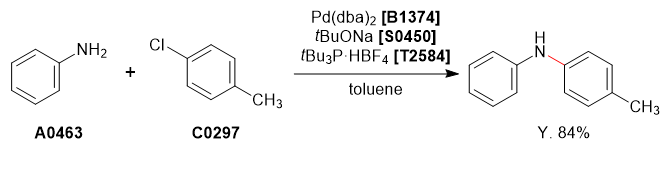
Aniline (1.0 g, 10.7 mmol) and 4-chlorotoluene (1.4 g, 11.8 mmol) were dissolved in degassed toluene (10 mL) under nitrogen atmosphere. To this solution was added sodium tert-butoxide (1.54 g, 16.1 mmol), tri-tert-butylphosphonium tetrafluoroborate (31.1 mg, 0.1 mmol) and Pd(dba)2 (61.7 mg, 0.1 mmol, 1.5mol%). The reaction mixture was refluxed for 24 h and cooled to room temperature and quenched with H2O (10 mL). The organic phase was separated and washed with brine (10 mL), dried over MgSO4 (10 g), concentrated under reduced pressure to afford the crude product as a brown liquid. The crude product was purified by column chromatography on silica-gel (hexane : ethyl acetate = 95 : 5) to afford the desired product as a pale yellow crystalline solid (1.21 g, 6.6 mmol, 62%).
Toluene was degassed by bubbling with N2 gas for 30 min.
The reaction mixture was analyzed by TLC (hexane : ethyl acetate = 1 : 1, Rf = 0.30) and GC.
1H NMR (400 MHz, CDCl3); δ 7.24-7.20 (t, J = 8.7 Hz, 3H), 7.07 (d, J = 8.7 Hz, 2H), 7.00-6.88 (m, 4H), 6.88-6.84 (m, 1H), 5.58 (s, 1H), 2.29 (s, 3H).

To a 3-necked 300 mL round bottom flask was charged with diphenylamine (5.01 g, 29.6 mmol, 1.0 eq.), 4-chloroanisole (4.48 g, 31.4 mmol, 1.05 eq.) and degassed toluene (150 mL). To this solution was added Pd2(dba)3 (0.287 g, 0.131 mmol, 1 mol%), tri-tert-butylphosphonium tetrafluoroborate (0.198 g, 0.683 mmol, 2 mol%) and sodium tert-butoxide (6.34 g, 66.0 mmol, 2.2 eq.). The reaction mixture was refluxed for 16 hr under nitrogen atmosphere. After cooled to room temperature, the reaction was diluted with CH2Cl2 (300 mL). The suspension was filtered and the filtrate was dried over Na2SO4 and concentrated under reduced pressure to afford the crude and brown solid. The crude product was purified by silica-gel column chromatography (hexane/EtOAc = 99/1 then 8/1) to afford the light brown solid (7.0 g) containing 10 mol% of diphenylamine. Removal of the residual diphenylamine by recrystallization from hexane (55 mL, 60 °C then 15 °C) gave 4-methoxytriphenylamine as a white solid (5.26 g, 65 %).
The reaction mixture was monitored by TLC (EtOAc/hexane = 1/10. Starting materials: Rf = 0.36 (diphenylamine), 0.59 (4-chloroanisole); target product: Rf = 0.46).
1H NMR (400 MHz, CD2Cl2); δ 7.26-7.17 (m, 4H), 7.10-6.98 (m, 6H), 6.98-6.91 (m, 2H), 6.89-6.82 (m, 2H), 3.79 (s, 3H).
13C NMR (101 MHz, CD2Cl2); δ 156.72, 148.56, 141.00, 129.39, 127.72, 123.12, 122.15, 115.05, 55.77.

La FDS demandée n'est pas disponible.
Nous contacter pour plus d'informations.
Un échantillon CoA pour ce produit n'est pas disponible pour le moment.
Le tableau analytique demandé n'est pas disponible. Nous sommes désolés pour ce désagrément.


